

Operation Southern Spear intensifies as Washington defends lethal actions against narco-trafficking networks amid rising debate over effectiveness and long-term impact
The United States military carried out a strike on a drug-trafficking vessel in the Eastern Pacific on Monday, killing two traffickers.
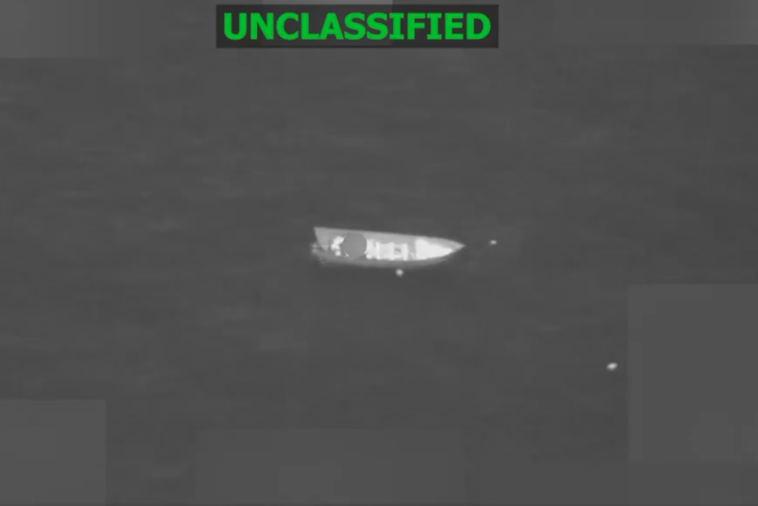
“On April 13, at the direction of [U.S. Southern Command] commander Gen. Francis L. Donovan, Joint Task Force Southern Spear conducted a lethal kinetic strike on a vessel operated by Designated Terrorist Organizations,” the U.S. Southern Command (SOUTHCOM) said in an April 13 post on X.
“Intelligence confirmed the vessel was transiting along known narco-trafficking routes in the Eastern Pacific and was engaged in narco-trafficking operations. Two male narco-terrorists were killed during this action. No U.S. military forces were harmed.”
SOUTHCOM did not identify which designated terrorist organization was operating the vessel.
A video accompanying the post showed the vessel stationary in open water before being destroyed by an explosion.
Earlier, on April 12, SOUTHCOM announced the destruction of two additional drug-smuggling vessels in the Eastern Pacific Ocean, resulting in the deaths of five traffickers.
On March 20, the command reported another strike on a drug vessel operated by a designated terrorist group, leaving three survivors.
Since September 2025, the U.S. military has conducted dozens of strikes targeting suspected drug-trafficking vessels in the Eastern Pacific Ocean and the Caribbean Sea as part of Operation Southern Spear, an effort aimed at curbing the flow of illicit narcotics into the United States.
The campaign has drawn both support and criticism.
Sen. Tom Cotton said in a Dec. 5 post on X, “The only reason the narco-terrorists didn’t flip their boat back over and continue their mission is because our military didn’t give them the chance. Arkansas, and America, is safer with that boat and those drugs destroyed.”
This month, Rep. Jamie Raskin argued in the House of Representatives that the strikes “fundamentally weaken our ability to bring cases against drug kingpins,” noting that the deaths of lower-level operatives prevent them from testifying against cartel leaders.
The Trump administration stated in a report to Congress that such strikes are justified following decades of largely unsuccessful law enforcement efforts to stem the flow of illegal narcotics into the country.
According to the report, drug cartels have become “more armed, well organized, and violent,” contributing to the deaths of tens of thousands of Americans annually.
The president determined that these cartels constitute “non-state armed groups,” designated them as terrorist organizations, and assessed their activities as an armed attack against the United States.
“The President directed the Department of War to conduct operations against them pursuant to the law of armed conflict,” the report stated. “The United States has now reached a critical point where we must use force in self-defense and defense of others against the ongoing attacks by these designated terrorist organizations.”
In a March 17 statement to the House Committee on Armed Services, Joseph M. Humire, performing the duties of assistant secretary of War for Homeland Defense and Americas Security Affairs, highlighted the operation’s impact.
As of March 10, U.S. authorities had conducted 45 kinetic strikes since the start of Operation Southern Spear, destroying 47 drug-trafficking vessels and killing 157 members or affiliates of narco-terrorist organizations, he said.
“The effects have been significant and profound. Since the first September strike, there has been a 20 percent reduction of movements of drug vessels in the Caribbean and an additional 25 percent reduction in the Eastern Pacific. These two maritime corridors are the origin source for follow-on flow into the U.S. Homeland,” Humire stated.
However, Gen. Donovan recently told the Senate that the strikes are not a long-term solution.
“We’ve seen changes in the narco-traffickers’ patterns,” he said.
Humire noted that in January 2026, the Department of War went 23 days without a significant strike in the Eastern Caribbean, largely because trafficking routes shifted eastward through Venezuela and Guyana into Suriname.
“The balloon effect has raised the costs to narco-terrorist organizations in the Eastern Caribbean, in both blood and treasure,” he said.