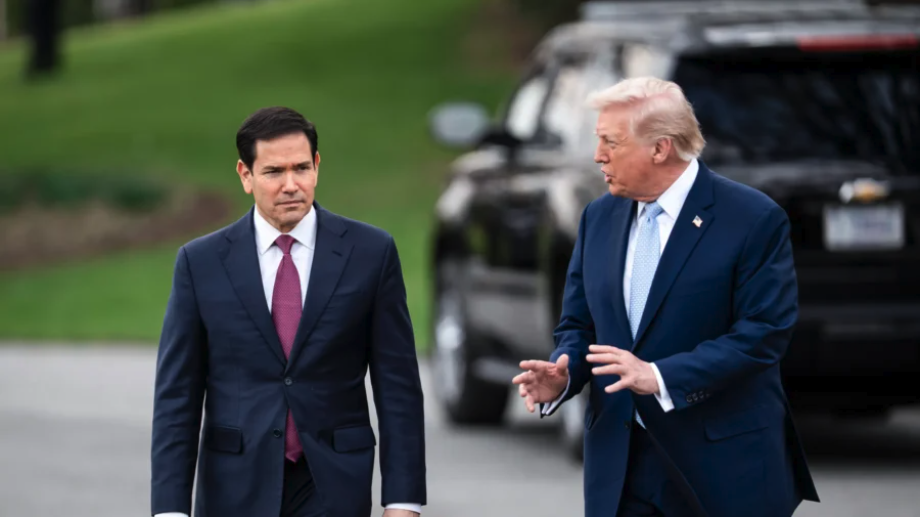


U.S. President Donald Trump on Wednesday said that shipping traffic through the Strait of Hormuz is “functioning” but acknowledged that vessels still face attacks.
"We got rid of the mines," the president told radio host Glenn Beck. "But the strait, it's functioning, it's a functioning strait. Yes, every once in a while there will be a drone or a rocket or something shot, but it is a very functioning strait. A lot of oil is pouring out."
Trump said 10 million barrels were transported through the strait on Tuesday, reiterating that “we cannot let Iran have a nuclear weapon.”
The comment came a day after the U.S. president wrote on social media that “all mines” apparently placed in the strait by Iran had been removed by the U.S. military and that ships believed to be laying mines would “be immediately and systematically destroyed.”
"There is a Zero Tolerance policy on mine placement in full force and effect," Trump said, adding that the U.S. Space Force is watching “every square inch” of the strait.
Earlier this week, U.S. Treasury Secretary Scott Bessent announced a new round of sanctions targeting Iran and warned every country doing business with Tehran to sever those financial ties or face U.S. sanctions.
Dubbing the campaign “Operation Economic Outcast,” Bessent said Trump had been “making phone calls to world leaders with specific requests to cease their interactions” with Iran and had already seen results.
“We are level-setting with every country to tell them our expectations. We know who they are. They know who they are,” Bessent said. “So when the hammer of U.S. Treasury actions falls upon them, they will have no one to blame but themselves.”
The Treasury Department also said Monday that it was imposing sanctions on nearly 60 Iran-linked entities, saying those companies have roles in Iran’s nuclear and missile programs, cyber activities, and oil shipments.
Iran’s Foreign Ministry spokesperson this week said Tehran would respond harshly to expanded U.S. sanctions, including measures against countries it sees as cooperating with Washington.
“Any escalation of this situation will undoubtedly bring about consequences,” Esmail Baghaei said. “Our hands are not tied.”
The Gulf supplied around a fifth of the world's daily traded crude oil and liquefied natural gas before the U.S.–Iran war disrupted tanker traffic. Since the start of the conflict in February, Iran has fired upon or threatened ships attempting to travel through the Strait of Hormuz, which links the Persian Gulf with the Indian Ocean.
The United States has maintained a military blockade of Iranian ports since mid-July, following new U.S. strikes that lasted about two weeks before they were called off in favor of the new economic pressure campaign. According to a Monday social media post by U.S. Central Command, 71 commercial vessels have been redirected, while three ships were disabled and two were boarded.
There has also been a U.S.-led effort to allow tankers to pass through the strait, U.S. Energy Secretary Chris Wright said in a social media post last week.
“On Tuesday, the U.S. military helped ship over 15 million barrels of oil and products out of the Strait of Hormuz — combined with pipelines, the total leaving the region is closer to 20 million barrels,” he wrote on X, saying that the “7-day average of oil leaving the Strait is over 8 million barrels a day.”